


Where There Is Light, There Is Shadow
by Dirk Dzimirsky
When drawing realistically, we encounter up to eight different elements of light and shadow that we need to identify correctly in order to achieve maximum realism. They are (from brightest to darkest) highlight, form light, base tone, form shadow, reflected light, terminator, cast shadow, and dark accent.
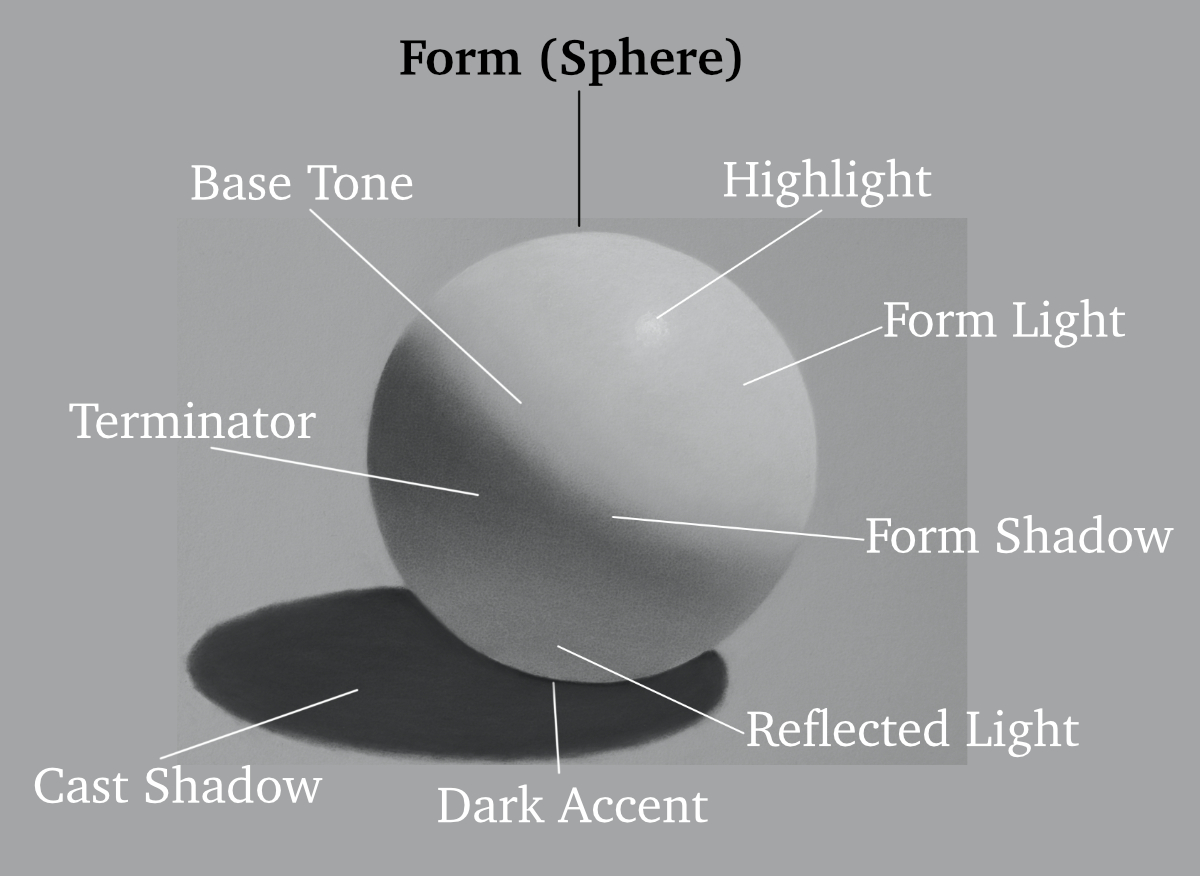
Here they are in detail:
Highlights
The brightest parts in your drawing, usually the white of the paper or very close to it. They make certain areas appear shinier and more alive. You can experiment with strategically exaggerating them for more “catchy” artwork. They usually appear on the edges of a form where the light is reflected directly toward our eyes, or as reflections of the light source, such as in the eyes.
Role in the Drawing
Highlights are on one end of a full tonal range (from white to black), with dark accents being on the other end of it. They bring attention to key areas and can make a drawing come alive. Slight exaggeration can increase visual impact, but overuse will reduce their effectiveness.
Form Light
The light that brightens the base tone of a form. It is strongest where the light hits the form directly and gradually becomes darker (toward the base tone) as the plane of the form turns away from the light, or as the curvature slowly moves away from it.
Role in the Drawing
Form light helps to describe the roundness of forms. Since it needs to differ from highlight (white), it means that form light is already shaded with graphite.
Base Tone
The tone (color in grey) of an object or a part of it. In a portrait, this could be the skin tone, as well as different base tones for the hair, clothing, or other elements. As a rule of thumb, think of the base tones as the actual tone of an object or form - as neither in light nor in shadow. Between form light and form shadow, there is always a transition that passes through the base tone. Without this transition, the change would appear as a sharp edge rather than a smooth shift in form.
Role in the Drawing
Establishing the correct base tones is the crucial foundation of any realistic drawing, as only then can all other tonal relationships function properly and work together harmoniously.
Form Shadow
When a form turns away from the light, its base tone gradually becomes darker and darker. If there were no ambient light to brighten that shadow, it would become pitch black—which we usually do not want.
Role in the Drawing
With form shadow, we control the form’s roundness, fullness, and three-dimensionality.
Reflected Light
Any surface reflects light (otherwise we would not be able to see anything). Smooth and bright surfaces reflect light more strongly than matte and dark surfaces, which absorb most of it. A form that is facing away from the main light (and is therefore in shadow) can still receive light from nearby surfaces that are facing the light. In that case, the shadow area becomes lighter—either strongly (with bright and smooth surfaces nearby) or only slightly.
Role in the Drawing
Reflected light adds to the sensation of depth and creates a rich atmosphere. Even subtle hints of it can make a big difference.
To better understand its importance and function, here is an example with and without reflected light.
Terminator
If reflected light brightens the form shadow, it behaves similarly to form light, but weaker and in the opposite direction. This means the reflected light area becomes darker as the form curves away from it (in this case, toward the main light). Therefore, the darkest part of the form shadow appears just before the reflected light area. This part is usually called the terminator.
Role in the Drawing
The terminator and reflected light work together. Without the terminator, we would not be able to clearly perceive the reflected light.
Cast Shadow
The shadow that an object casts onto another surface. This shadow is usually darker than a form shadow on a similar surface. When a cast shadow falls across other forms, it also describes their structure—so it is important to capture it accurately to avoid distorting the underlying forms.
Role in the Drawing
The edge of a cast shadow can range from sharp to very soft, depending on the light source. Because of this, it is often overlooked. However, even subtle indications of cast shadows are essential, as they enhance the sense of depth and three-dimensionality. They help push forms forward (when they cast the shadow) or back (when they receive it). For example, a cast shadow from the upper lip onto the teeth will clearly push the teeth back in space, reinforcing their position behind the lip.
Dark Accent
When two forms touch, they create a small shadow between them. Hold up your index fingers and move them together—once they touch, you will notice a dark line forming between them. They are the darkest from all the other shadow types.
Role in the Drawing
Dark accents act as a counterbalance to highlights. They enhance depth and contribute significantly to making a drawing feel alive. Without them, the drawing feels clearly as if something is missing. Just like with the highlights, using them strategically can guide the viewers attention to important parts of the drawing.
Why Is This Important?
Think of a hyperrealistic drawing as a highly detailed and precise report—which, in many ways, it is. If all the information is presented clearly and in a structured way, it becomes easy to understand and visually engaging.
But if the information is mixed up—full of inconsistencies, unclear relationships, or missing elements—the result becomes confusing. Just like a poorly written report, the viewer can no longer make sense of it and will lose interest.
How Does This Relate to a Hyperrealistic Drawing?
If your base tone in an area is too light, your form light becomes even lighter and starts to enter highlight territory. In simple terms, you run out of room for highlights. This is similar to leaving out important information—key elements lose their clarity and impact.
On the other hand, if your form shadow becomes too dark, you lose all visible information in that area. This is like blacking out entire sections of a report. It also weakens the effect of cast shadows and dark accents, as different elements begin to merge instead of serving distinct roles.
Depending on your current level of experience, some of these concepts may feel advanced or not immediately relevant. However, over time, their importance will become clearer. Understanding and controlling these relationships is essential for progressing to a higher level of realism and mastery.